Why clients always give you their stuff late
Payroll information the day before payday. VAT records turning up long after the quarter has closed. Year-end paperwork that arrives when the filing deadline is close enough to be interesting.
Every firm has this. Most firms have decided it is simply what clients are like.
It is not. There is a reason, and it is uncomfortable.
Being early has never been worth anything to them
Look at it from the client's side. They send their records five days before the deadline and pay you £250 a month. Or they send them at one minute to midnight and pay you £250 a month.
Same fee. Same service. Same slightly harassed accountant getting it done.
Given those two options, a reasonable person picks the one that suits them, which is nearly always later. They are not being difficult. They are responding correctly to the incentives you have set.
Their records are late because you have never given them a reason for them to be early.
So they leave it, you scramble, and you are the one who pays for it in evenings and weekends. The client never sees the cost, because the cost never reaches them.
Why "please send it earlier" does not work
Every firm has tried asking. Reminder emails, a friendly note in the engagement letter, a deadline three weeks before the real one that everybody knows is three weeks before the real one.
It fails for the same reason. A request is a preference. There is nothing behind it.
Worse, systematically asking and then absorbing it when nothing changes teaches the client that your deadlines are advisory. The next request carries less weight than the last one.
You cannot change client behaviour by asking. You change it by pricing it.
What that sounds like
It is one sentence, said at the point you agree the fee.
"This is our price if the information reaches us five working days before the deadline. And this is our price if you want to be able to hand it over at the last minute, because in that case we hold capacity spare for you."
That is it. No lecture about how busy January is.
Notice what it does. It does not tell the client they are wrong to want to be late. Some of them genuinely cannot be early - their own customers pay them late, their business is seasonal, their bookkeeper is one person. It just says the two things are different, and prices them differently.
And either answer is a good answer for you.
- They choose early, and your workload flattens out. The pile stops arriving in the last fortnight.
- They choose late, and you are paid for the pressure instead of absorbing it. The evening in January is still an evening in January, but it is one you were paid for.
The only outcome you were getting before was the second one without the fee.
This is not a penalty, and it should not sound like one
The framing matters more than the mechanism.
A late fee is a punishment. It arrives after the fact, it is a surprise, and it makes the client feel caught out. It also gives them something to argue about, which is time you will never recover.
What is described above is a choice, made in advance, with both prices visible. The client picks. Nobody is caught out, because nothing happens after the fact.
It also happens to be true. Holding capacity open so that somebody can hand you their records at the last minute genuinely costs you something. You are carrying the risk of their timing. That is a real service, and it is reasonable to be paid for it.
The same idea applies wider than deadlines
Timing is the clearest example, but it is one of a family.
How good their records are when they arrive. Whether they are on proper software or sending you photographs. How they prefer to work with you. Whether they want you reachable within the hour or within the week.
Every one of those is a real difference in what you are being asked to provide, and every one of them is usually absorbed silently.
None of these are charges for your time. They are facts about the client's own circumstances and preferences, which the client can recognise and agree with. That is what makes the resulting fee explainable rather than something to be haggled over.
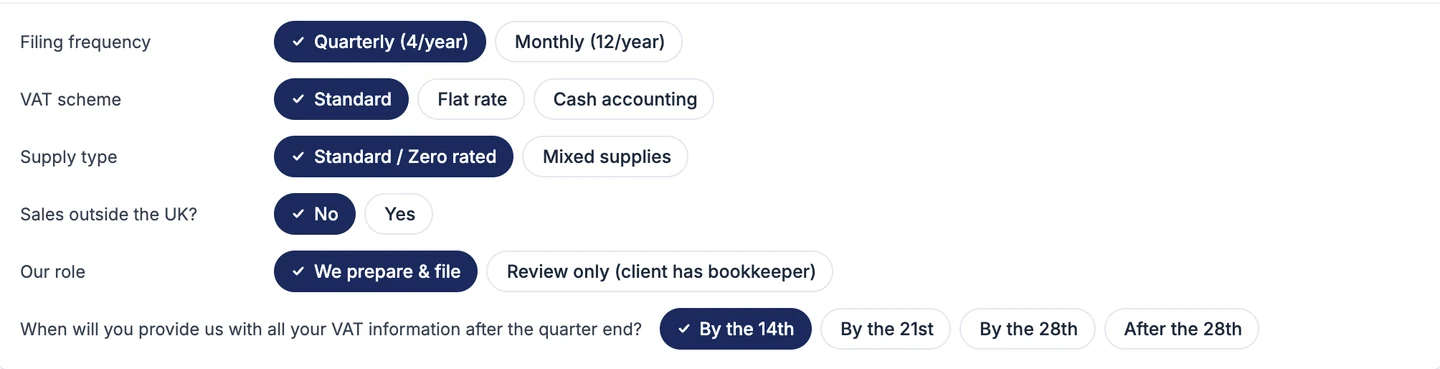
In Power Pricing these sit inside the services themselves, as questions you answer while scoping. When the client will get their information to you. What state their records are in. How they want to work with you. The fee moves as you answer, in front of them, so the price they see is visibly a consequence of their own answers rather than a number you produced afterwards.
Where to start
Do not roll this across your whole client base on Monday.
Take the next new client you quote for and put the choice in front of them. See what they pick and see how it feels to say.
Then at each renewal, for the clients whose timing genuinely costs you, put the same choice in front of them. Some will move their behaviour. Some will pay for the pressure they cause.
Either way you stop being the only person in the arrangement who carries the consequences of when the records show up.