Your engagement letter is older than ChatGPT
When did you last update your engagement letters?
If the honest answer is "a few years ago, and mostly I copy the last one and change the name", you are in the same position as most firms. It is not negligence. Engagement letters are the sort of thing you set up once, properly, and then never think about again because they appear to be working.
The trouble is that three things have changed underneath them.
First, what an engagement letter is for
Worth being clear about this, because it shapes everything else.
Your engagement letter is not there to satisfy your professional body. They do not approve anyone's letters. They publish guidance, and the guidance moves on, but nobody checks your file and signs it off.
It is there to protect you when a client says you should have done something you did not do, or should not have done something you did. That is the only moment it matters, and by then it is too late to improve it.
An engagement letter earns its keep on one day, and you do not get to choose which day that is.
1. Artificial intelligence
Most firms are now using AI in some form. A general assistant for drafting, a research tool, something built into the software you already pay for, or a specialist tool aimed at accountants.
Most engagement letters written before that became normal say nothing about it at all.
Which leaves an awkward gap. Your confidentiality clause says you will not disclose the client's information to third parties without consent. If client information is going into a tool run by somebody else, a reasonable person could argue that is exactly what has happened, and your letter does not cover you.
There is a second reason to say it out loud. Some clients are genuinely not comfortable with it, and would rather you asked. Finding that out at the start of an engagement is a short conversation. Finding it out after the fact is a different one.
2. Outsourcing and overseas staff
This is the one with real regulatory teeth, and the one most firms are quietly offside on.
Look at the standard confidentiality wording. It says something close to: we will keep your affairs confidential and will not disclose information to third parties without your consent.
Now think about who actually touches client data in your firm. The freelancer you bring in at year end. The outsourcing provider you signed up with last year. The bookkeeper you hired directly overseas who logs into your systems every morning.
Every one of them is a third party as far as that clause is concerned.
Two things make this more than a technicality. UK GDPR requires you to tell clients about the categories of people who receive their data, which means disclosure is not optional. And the Information Commissioner's position since Schrems II is that what matters is where the person is, not where the server is - so a remote worker abroad logging into a UK system is still an international transfer, even though the data never appears to leave.
Both ICAEW and ACCA expect disclosure. If you outsource in any form and your letter is silent on it, your confidentiality clause is technically in breach of itself.
Fixing it is not complicated. One paragraph covering UK contractors, overseas providers and remote access, so the client knows and has agreed.
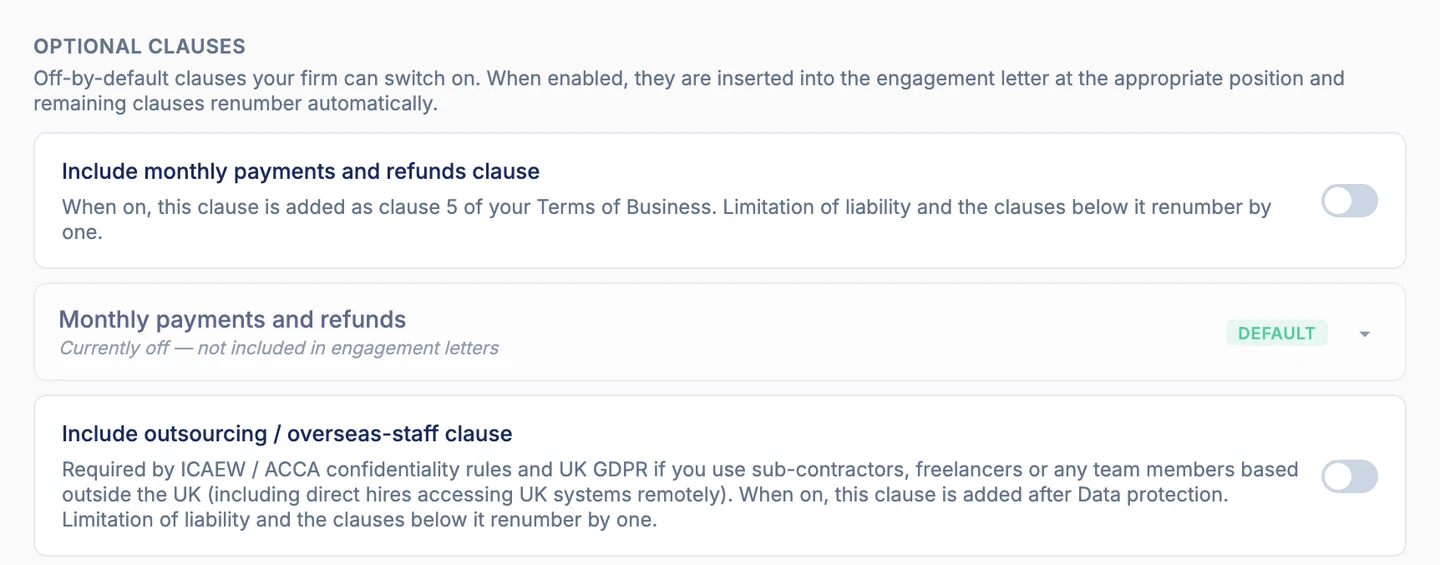
3. What monthly payments buy
This one costs firms actual money, every year, quietly.
Here is the scenario. It is March. A client emails to say they are moving to another accountant. They have paid you nine monthly instalments. Their year end has not been reached, so the accounts have not been prepared.
A week later the new accountant rings. They have paid you for nine months, you have not filed anything, and the new firm is charging them to do the accounts. Can you refund the nine months?
Read your engagement letter and see what it says. Most letters cover notice periods and outstanding fees. Very few say what the monthly payments were for. And in that silence, the client's assumption - that they were instalments towards a job that never happened - is not obviously wrong.
So you either refund, or you have an argument, and neither is a good use of your March.
The clause that solves it sets out what each monthly payment actually covers: the ongoing access to advice, your continuing role as their agent with HMRC, and the work already scheduled and resourced for them. Once a month has been paid, it has been paid.
This is the clause I am proudest of writing, because it is the one that has most obviously paid for itself.
None of this is about volume of paperwork
A longer engagement letter is not a better one. Every clause above earns its place by covering something that actually happens, to real firms, most years.
Worth doing this weekend: open your current letter and search it for three things. Artificial intelligence. Outsourcing. Refunds. If none of them appears, you have found your afternoon's work.
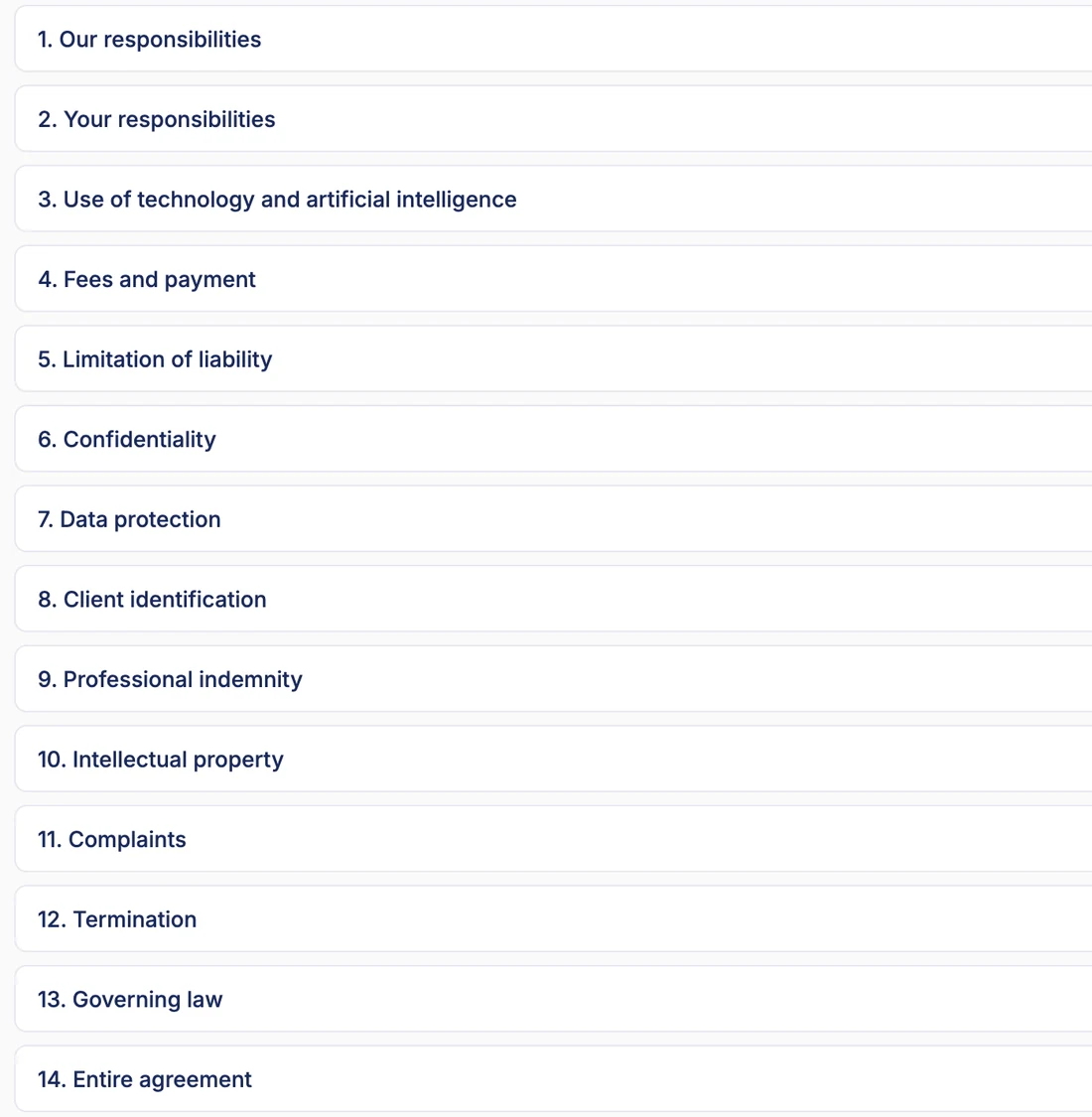
In Power Pricing all three are in the template as standard, in plain English, and each one can be switched off if it does not apply to how you work. The letter is generated from the proposal, so it matches the services you actually quoted rather than whatever was in the last client's document. And when the guidance moves, the templates move with it.
But whether you use anything of mine or not, go and look at your letter. It is the only part of your client relationship that exists solely for the day something goes wrong.