It is not MTD that is the problem. It is the pricing.
Spend ten minutes in any accountants' forum at the moment and you will find the same thread. Four times the client contact. Hours lost helping people set up software. Twelve-hour days. And clients reacting badly to higher fees, with the occasional one walking out altogether.
Everyone in those threads agrees they need to charge more. Almost nobody seems sure how to make the higher fee stick.
The workload is real. But the reason it hurts as much as it does is not the workload.
A £300 tax return was never priced to include a relationship
Take a sole trader who has been paying you a few hundred pounds a year for a Self Assessment return. What that fee was built to cover is one job, done once, after the year has finished.
What Making Tax Digital for Income Tax asks of you is a different shape entirely. Four quarterly updates. A final declaration. Digital records that have to stay in order all year rather than arriving in a carrier bag in December. Software the client has to actually use, which means questions when they cannot. And because you are now touching their affairs every three months, they start contacting you like somebody who is involved in their business, because you are.
None of that is a bigger tax return. It is a monthly service being paid for at once-a-year prices.
The firms drowning right now are the ones charging a few hundred pounds a year and giving the year-round contact away free.
And here is the part that catches people out. The client who rings every few weeks is not the problem. If your fee includes access, that client is already paid for. It is only when access is unpriced that a client asking questions feels like something being taken from you.
Price the cycle, not the submissions
The instinct is to count submissions. Five filings instead of one, so five times something.
Resist it, for two reasons.
The first is that it is not true to the work. Most of the effort in an MTD year is not in the act of filing. It is in keeping the records straight, chasing what is missing, answering the questions, and holding the client's hand through software they did not ask for.
The second is that it invites exactly the argument you do not want. Price per submission and you have told the client the submissions are the product. Now they are entitled to ask why one costs what it does, and whether the quiet quarter should cost less.
Price the whole cycle as a monthly fee instead. Quarterly updates, the final declaration, the records, and you being reachable in between. One number, every month, for the year-round relationship.
The four things that should actually move the price
Different MTD clients are genuinely different amounts of work, and it is worth being precise about what makes them different, because that is what you will be explaining.
How good their records are. A client on proper software who reconciles as they go is a different proposition from one who sends a folder of photographs. If you are doing the bookkeeping yourself, that is a different service again and should be priced as one.
How many income sources they have. A sole trade plus two rental properties is not one client, it is several sets of records that each need to be right before anything can be submitted.
How much hand-holding they need through the year. Some clients will never contact you between quarters. Others will need talking through the software every single time. Both are fine. They should not pay the same.
Whether there is property income. Rental portfolios bring their own record-keeping, their own allowances and their own mistakes to catch.
Notice that none of those is "how long it takes me". They are all facts about the client's circumstances that you can point at and the client can recognise. That is what makes a fee explainable rather than negotiable.
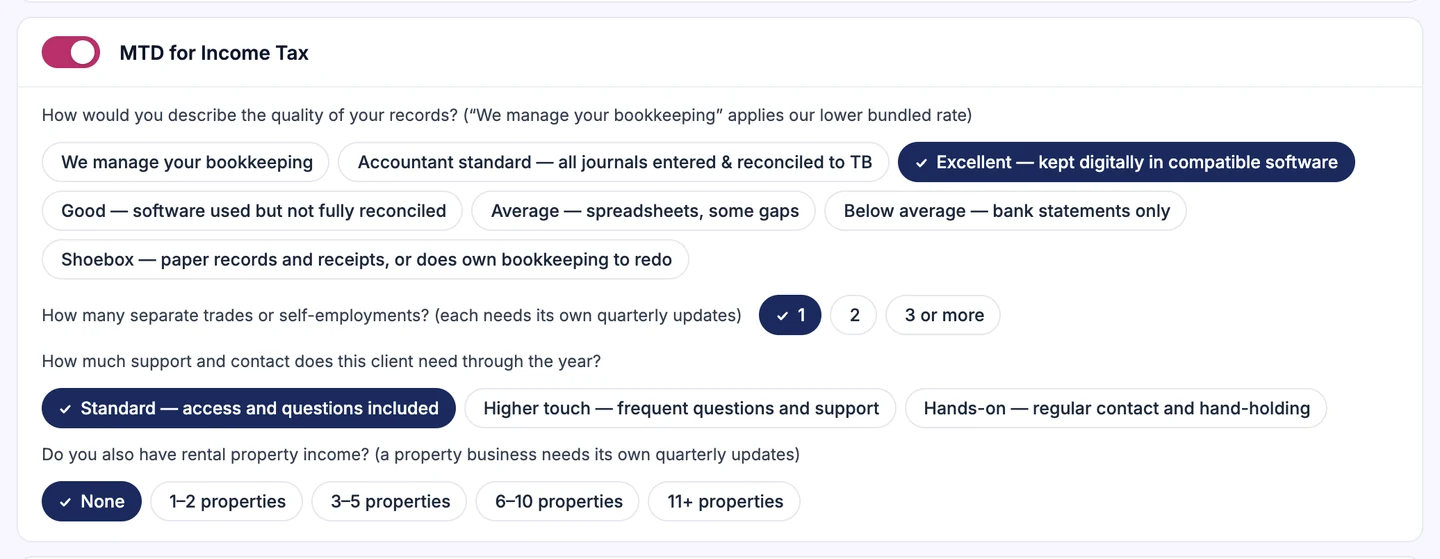
A straightforward client should land at your minimum monthly fee. An involved one should land higher, automatically, for a reason you can show them.
Having the conversation
The fee increase is not the difficult bit. The difficult bit is that it usually arrives as a number in an email with no story attached.
A client who has been paying you £300 a year and receives an email saying it is now £100 a month has been told their fee has quadrupled. That is all the information they have, so that is the conversation you get.
The same client, shown what the year now involves - four submissions instead of one, digital records that have to stay current, someone to ring when the software will not behave, and a final declaration that replaces the tax return they used to pay for separately - is being told something else entirely. They are being told what they are getting.
Two things help here, and neither is a sales technique.
The first is putting it in writing, in the engagement letter, before it starts: what you do each quarter, what they have to do, and when. Most of the arguments come from a client discovering their obligations in month seven.
The second is being clear that the final declaration replaces Self Assessment. Otherwise a reasonable person assumes you are now charging for the quarterly work and the return they always paid for, and they are right to push back on that.
Do it now, not in February
With the next band coming into mandation in April, there is a window where this is a conversation about the year ahead. After that it becomes a conversation you are having while doing the work, which is a worse conversation and a worse position.
Firms sending MTD quotes now are agreeing a fee for a service that has not started. Firms sending them in February will be asking for more money from people already mid-cycle and already unsettled.
Where this leaves you
MTD is being experienced across the profession as a workload problem. For most firms it is really a pricing problem that MTD happened to expose.
A once-a-year return at a once-a-year fee could absorb a certain amount of goodwill. A year-round service at a once-a-year fee cannot, and no amount of efficiency will make it.
The firms who come out of this well will not be the ones who worked hardest at it. They will be the ones who priced it as what it is, and showed the client the value in writing.
If you want the mechanics of that - what to put in the engagement letter, and how to price a client's circumstances rather than your hours - the walkthroughs below cover both.