Three prices or one?
When you send a prospect your fee, do you give them one price, or three?
Most firms send one. It feels cleaner. You have worked out what the job is worth, you put a number on it, and you wait.
The trouble is what that single number asks them to decide.
One price only ever asks yes or no
Put one figure in front of somebody and you have handed them a closed question. They can accept it or they can decline it. And because those are the only two doors in the room, a third one appears on its own: can you do it a bit cheaper?
That question is always sitting on the table when there is only one price. You have given the prospect nothing else to think about, so the only thing left to have an opinion about is the number itself.
It is worth being honest about what happens next. You either hold firm, which can feel like a standoff five minutes after meeting someone, or you shave a bit off to keep things pleasant. If you shave a bit off, you have taught that client one thing on day one: asking works. They will ask again at the renewal, and every renewal after it.
Now give them three.
The question stops being "shall I buy this?" and becomes "which one of these is right for me?"
Nothing about your work has changed. You have not sold harder, or added a page to the proposal, or rehearsed a line about value. You have changed the decision in front of them from a yes-or-no into a choice.
Why it works
Three things happen, and they are separate mechanisms rather than three ways of saying the same thing.
The conversation moves off price. Once there are options, the prospect spends their attention comparing what is in each one. They are working out which level of service suits them, not whether your fee is too high. Price is still there, but it is no longer the only thing to react to.
The top option gives the middle one a job. A price on its own means nothing, because there is nothing to measure it against. Put a premium package above your recommended one and the recommended one stops looking expensive and starts looking sensible. That is not a trick played on the client. It is how people judge every price they have ever paid, including the ones they were happy with. Without a reference point, every fee looks like a number somebody made up.
Some clients pick up. Not most. But a meaningful few will look at the top option, decide they want the extra access, and choose it without you having to push at all. Those clients were always willing to pay more. A single price simply never gave them the chance to say so.
What the three options should actually differ on
This is where firms go wrong. The instinct is to build three genuinely different pieces of work, which means three lots of scoping, three sets of figures and three ways for the engagement letter to be wrong.
You do not need to. The compliance work in each option can be identical. What changes is the level of access, the speed you commit to, how much of the year you spend alongside them rather than behind them, and how much of the worry you take off their desk.
That is what your clients are buying anyway. Nobody wants a set of accounts. They want to stop thinking about the accounts. Some of them want that a great deal more than others, and they will tell you which, if you give them somewhere to say it.
Two people on the same flight, paying different fares
Think about two passengers sitting in the same row of the same aircraft, going from the same airport to the same airport.
One booked three months ago and paid £50. He is delighted, because he planned ahead and got a bargain. The other booked yesterday and paid £150. He is also delighted, because there was a seat available on the morning he needed to be there.
Three times the price, same row, same destination, and both of them feel they got value. Not because one of them was fooled, but because they wanted different things. The first values his money more than his time. The second had a meeting.
Now the important part. Neither of them sat down beforehand and worked out which sort of buyer they were. They found out by being shown the options and noticing which one they reached for.
People do not arrive knowing what they value. They discover it when they are given something to choose between.
Which is why a single price is not neutral. It looks like the modest, straightforward thing to do, but it quietly decides on the client's behalf that they are the £50 passenger, and it never lets them tell you otherwise.
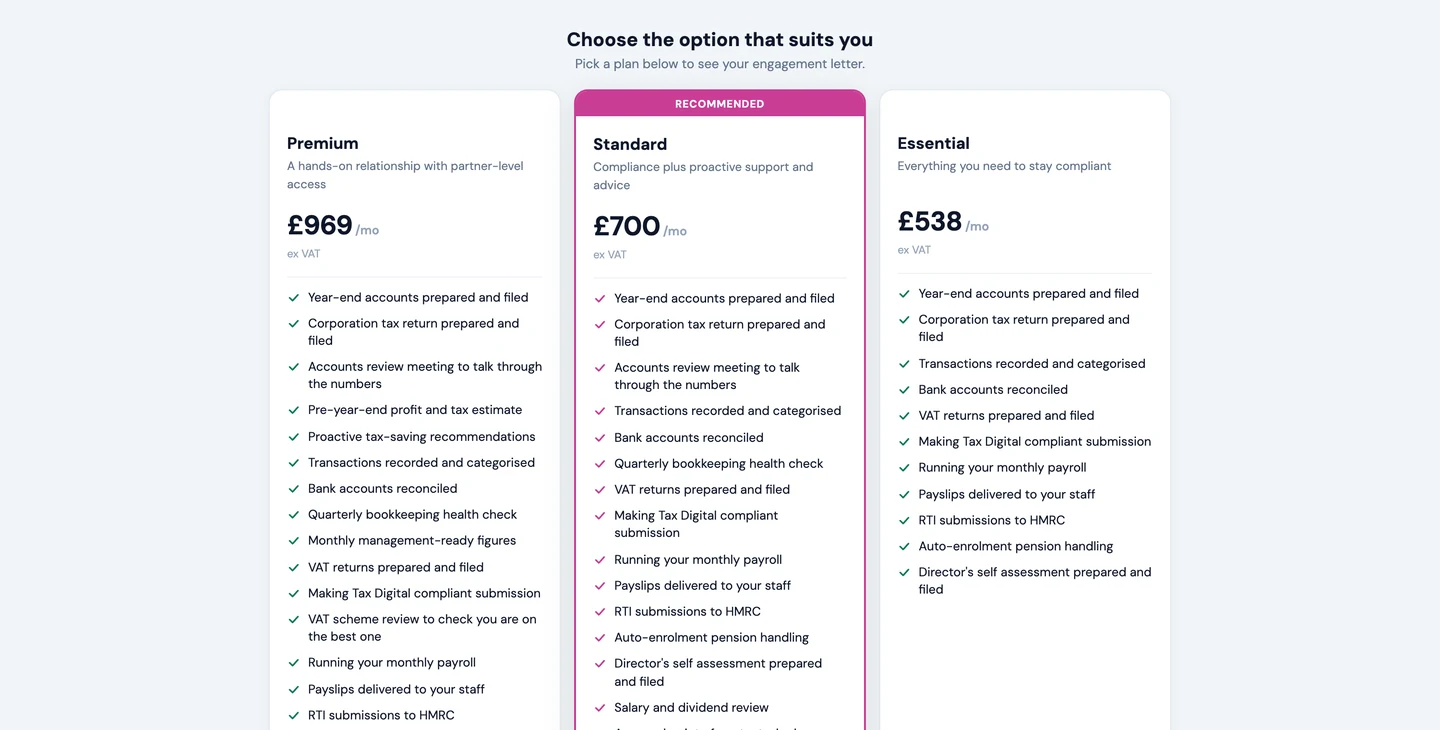
Here is what that looks like when a client opens the proposal. The filing work is the same in all three columns. What builds up as you move left is the access.
But will they not just take the cheapest?
Some will. That is fine, and it is worth thinking about why.
A client who takes the entry option has told you something useful for nothing: they want compliance done properly and they do not want much else. They are not a problem client. They become one only if you priced the entry option below what that work is worth, then delivered the middle option anyway because you felt you should.
So the entry option has to be a real option. Not a decoy, not a stripped-out version you would resent delivering. It is your compliance service at a fee you are content with, with the access sitting in the tiers above it. If you would be annoyed to win it, the number is wrong, not the idea.
And the pattern across a client base is what matters, not any one client. If a handful move up who would otherwise have taken your single price, your average fee has gone up without you having a single difficult conversation.
Where to put your existing price
In the middle.
Your current number is almost certainly your compliance work plus the access you already give away without charging for it. That is the middle option. The entry option is that same work without the year-round hand-holding, and the top one is what you would do for somebody who wanted you properly involved.
Do not invent a new middle. You already have it. What you are doing is putting a floor underneath it and a ceiling above it, so it stops being the only thing in view.
The reason most firms do not do this
Building three proper options by hand, in Word, for every prospect, is a job. Three sets of figures, three descriptions, three fee schedules, and an engagement letter that has to match whichever one they choose. Do that a few times, on top of everything else in a week, and you quietly go back to sending one price.
That is the actual reason three-option pricing is rare in accountancy, and it has nothing to do with whether it works.
It is also why I built the three-option view into Power Pricing. You price the job once, the way you always would. The software builds the other two from an uplift you set yourself, the client sees the comparison above rather than three attachments, and the engagement letter fills itself in for whichever one they sign. Minutes rather than an afternoon, which is the difference between doing it and meaning to.
Try it on your next quote
You do not need any software to find out whether this is true for your firm.
Take the next quote you were about to send as a single figure. Put that number in the middle. Add a lighter option below it and a fuller one above it, and let the differences be about access and involvement rather than about which forms get filed.
Then send it, and watch which one comes back.